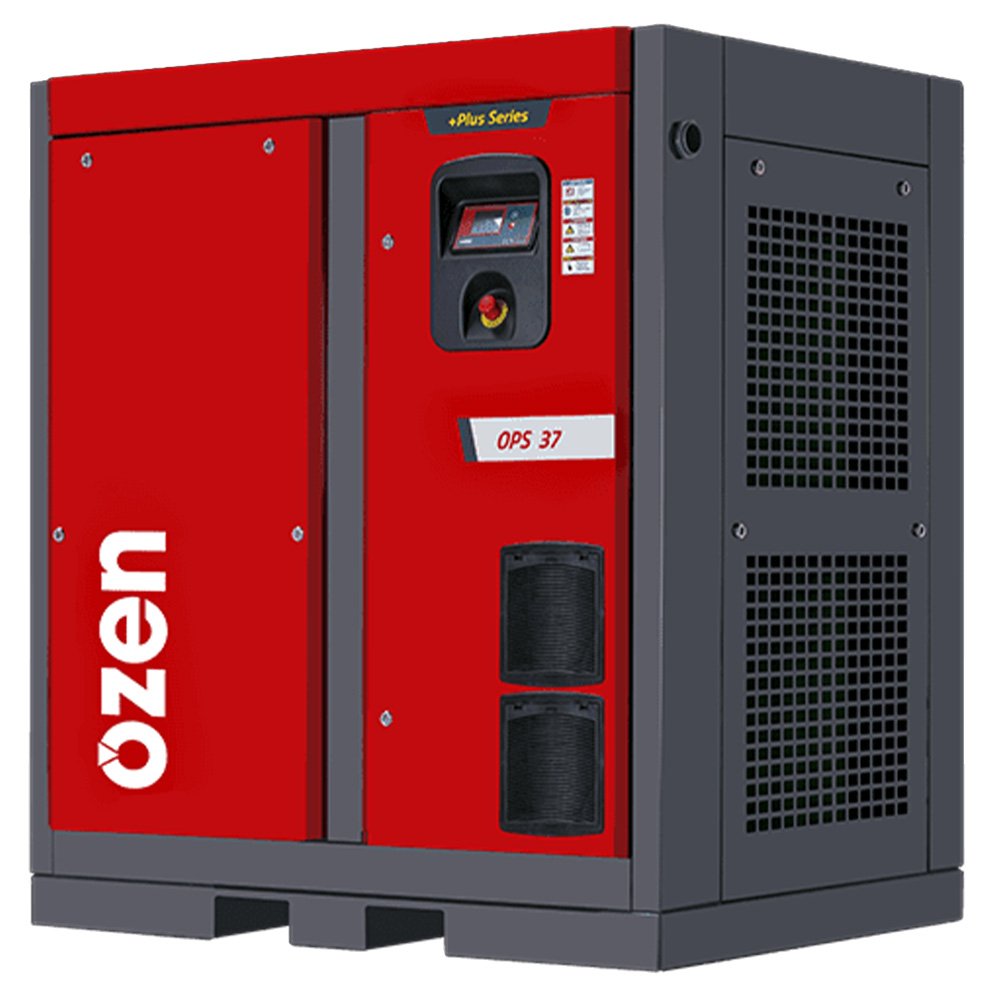
Preventive maintenance keeps an industrial air compressor reliable, efficient, and safe. The correct schedule depends on compressor technology, lubricant, operating hours, ambient conditions, and manufacturer instructions. The checklist below is a planning guide and does not replace the equipment manual or qualified service procedures.
Daily or shift checks
- Review controller alarms, operating pressure, temperature, and loaded hours.
- Check lubricant level using the manufacturer’s specified shutdown condition.
- Listen for unusual vibration, bearing noise, air leakage, or belt noise.
- Inspect for lubricant, condensate, and cooling-water leaks.
- Confirm automatic drains discharge correctly without leaking continuously.
Recording normal readings makes developing problems easier to identify. A gradual increase in discharge temperature or pressure differential is more useful when compared with a reliable baseline.
Weekly checks
- Inspect and clean intake and ventilation openings.
- Check cooler surfaces for dust, oil film, or restricted airflow.
- Verify receiver and treatment-system drains.
- Walk the nearby distribution system and repair audible leaks.
- Confirm the compressor room is not recirculating hot discharge air.
Monthly checks
Review operating hours, loading percentage, unloaded running, energy use, and alarm history. Inspect electrical connections only under approved isolation procedures. Check belts, couplings, hoses, and flexible connections for wear according to the manufacturer’s instructions.
Also review pressure drop across filters and air dryers. Treatment equipment can increase compressor energy consumption when it is neglected.
Service-interval tasks
Replace lubricant, oil filter, inlet filter, and air/oil separator at specified intervals for oil-injected rotary screw compressors. Reciprocating compressors require inspection of items such as belts, valves, rings, and crankcase lubricant. Oil-free machines have their own technology-specific service requirements.
Use the correct lubricant and genuine-equivalent consumables. Mixing lubricant types or extending separator life beyond condition limits can cause overheating, excessive pressure differential, and downstream oil carryover.
System-level maintenance
The compressor should not be maintained in isolation. Inspect receivers according to local safety requirements, test drains, check ventilation, verify safety devices through qualified personnel, and review the distribution network for leaks and excessive pressure loss.
Track these maintenance indicators
- Discharge temperature and ambient temperature.
- Loaded, unloaded, and total running hours.
- Separator and filter differential pressure.
- Dryer dew point and drain performance.
- Energy use per unit of delivered airflow, where measured.
- Repeated alarms and unplanned shutdown causes.
When to request service support
Stop and investigate recurring high-temperature alarms, rapid lubricant loss, abnormal vibration, electrical odors, safety-device activation, or a sudden reduction in delivered pressure. Do not repeatedly reset a protective shutdown without finding its cause.
For a new or replacement compressor, browse our rotary screw compressor range. You can also contact our team with the model, running hours, symptoms, and operating conditions.