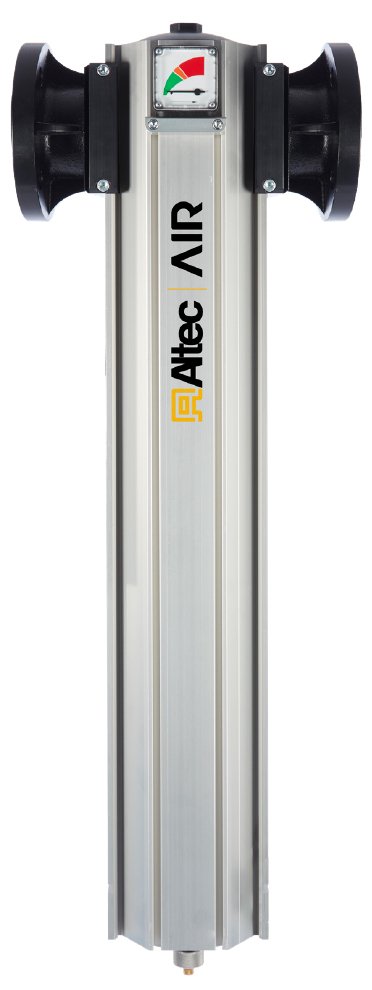
Compressed air can contain solid particles, condensed water, lubricant aerosols, hydrocarbon vapors, and contamination from the distribution system. No single filter removes every contaminant. A reliable treatment system uses the correct filter grades in the correct order.
Water separators
A water separator removes bulk liquid carried in the airflow, commonly using centrifugal action. It should be installed with a correctly functioning drain. A separator reduces the liquid load on downstream equipment but does not remove water vapor or replace an air dryer.
Particulate filters
Particulate filters capture solid contamination such as rust, pipe scale, and desiccant dust. They are commonly installed downstream of desiccant dryers and at points of use where sensitive equipment needs additional protection.
Coalescing filters
Coalescing filters remove fine liquid aerosols by combining small droplets into larger droplets that drain from the housing. They are used to reduce oil and water aerosol loading before critical processes or desiccant dryers. Correct drainage and element orientation are essential.
Activated carbon filters
Activated carbon media targets oil vapor and hydrocarbon odors that pass through particle and coalescing filters. These filters are used when the application requires very low residual oil vapor. They must be protected from liquid contamination and replaced according to actual service conditions.
How filters are arranged
A typical system may use a bulk water separator, general-purpose coalescing filter, high-efficiency coalescing filter, dryer, and final particulate or activated carbon stage. The exact sequence depends on compressor type, dryer technology, and required air quality.
Adding more filter stages without a defined quality target is not automatically better. Each stage creates pressure drop and maintenance work. The treatment train should deliver the required air quality with the lowest practical lifecycle cost.
Selection factors
- Maximum corrected airflow at minimum operating pressure.
- Contaminant type and required outlet quality.
- Connection size and flow direction.
- Maximum pressure and temperature.
- Initial and terminal differential pressure.
- Manual, float, or electronic drain requirements.
Maintenance and pressure drop
Filter elements may look clean while their differential pressure is already excessive. Monitor the pressure indicator where provided and use a time-and-condition-based replacement schedule. A blocked element increases system pressure demand and energy consumption.
Drain function should be checked routinely. A failed closed drain allows liquid to accumulate, while a failed open drain creates a continuous compressed-air leak.
Explore available compressed air filters and separators, or send us your airflow and air-quality target for a suitable filtration arrangement.