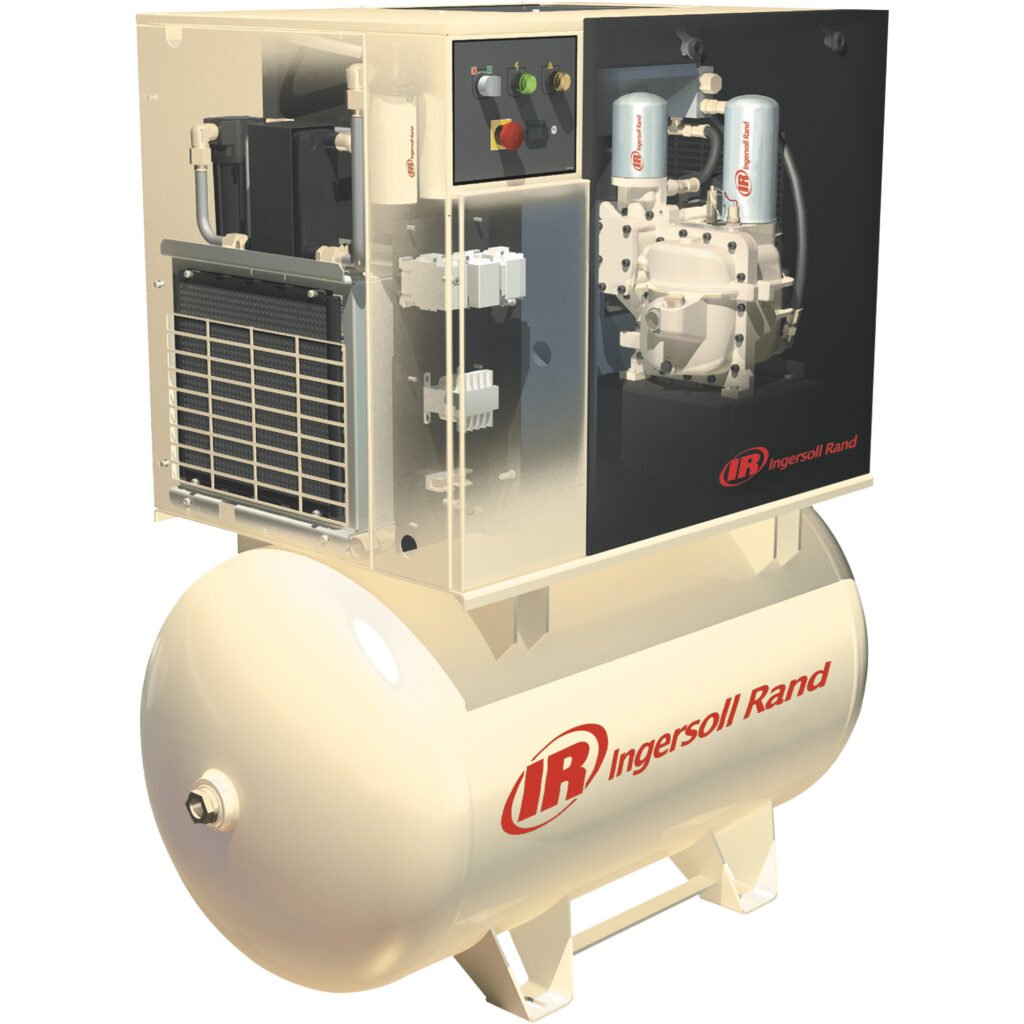
The choice between a rotary screw and reciprocating air compressor should be based on how the system will operate. Both technologies can produce reliable compressed air, but their strengths appear under different duty cycles, airflow requirements, and installation conditions.
How the two technologies work
A reciprocating compressor uses pistons moving inside cylinders. Air is drawn into the cylinder, compressed, and discharged into a receiver. A rotary screw compressor uses two intermeshing rotors to compress air in a continuous process. This difference affects vibration, temperature, airflow delivery, and suitable operating hours.
Duty cycle and operating hours
Reciprocating compressors are often effective for intermittent demand where the machine has adequate time to cool between loaded periods. Rotary screw compressors are commonly selected for production facilities that require long operating hours and a stable supply of air.
A piston compressor should not be selected only because its maximum pressure and horsepower match the application. Its allowable duty cycle must also match the actual load profile. Repeated operation beyond that duty cycle can increase temperature, oil carryover, and component wear.
Airflow and pressure stability
Rotary screw compressors deliver smoother airflow with lower pulsation, which can simplify pressure control in a continuous industrial system. Reciprocating units produce air in pulses and commonly rely on a receiver to buffer demand. Either technology can work well when the receiver and controls are correctly sized.
Energy efficiency
Efficiency depends on the operating point. A fixed-speed rotary screw compressor that spends long periods unloaded may waste energy. A correctly sized piston compressor can be economical for low-use applications. For widely varying industrial demand, a variable-speed rotary screw compressor or a sequenced multi-compressor system may reduce unloaded running.
Noise, vibration, and installation
Reciprocating compressors generally produce more vibration and a more noticeable pulsating sound. Foundations, vibration isolation, and placement may therefore require additional attention. Enclosed rotary screw packages usually provide lower operating noise, although cooling airflow and service clearances remain essential.
Maintenance considerations
- Reciprocating: check valves, rings, belts, lubrication, and cylinder-related wear.
- Rotary screw: maintain air/oil separators, oil and air filters, lubricant, coolers, and drive components.
Maintenance cost should be compared at the expected annual operating hours. The availability of qualified service and genuine consumables is as important as the nominal service interval.
Typical selection guide
Choose a reciprocating compressor when demand is intermittent, airflow is moderate, and a lower initial cost is important. Choose a rotary screw compressor when the facility needs continuous air, stable pressure, lower noise, and an integrated industrial package.
The final selection should still be checked against airflow, pressure, air quality, electrical supply, and lifecycle cost. Contact Central Asia Compressors to compare suitable configurations for your operating profile.