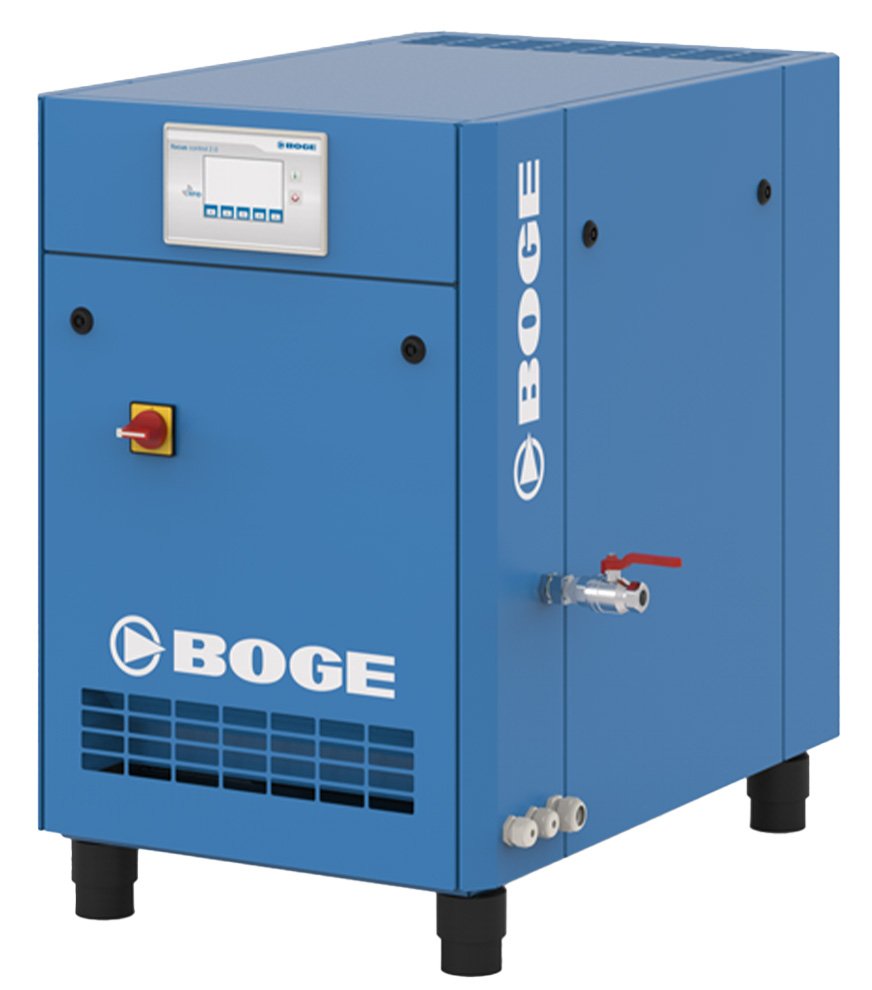
Oil-free compressed air is selected when lubricant contamination could affect product safety, process quality, regulatory compliance, or sensitive equipment. The decision should be based on a documented air-quality requirement and contamination risk assessment.
Not every application requires an oil-free compressor, and not every oil-free compressor installation automatically delivers the required air quality at the point of use. Intake-air quality, dryers, filters, piping, and maintenance all influence the final result.
Oil-free compressor versus treated air
An oil-injected compressor introduces lubricant into the compression process and uses separation and downstream treatment to reduce carryover. An oil-free compressor does not introduce oil into the compression chamber. It can reduce a major contamination source, but airborne hydrocarbons and contamination already present in the distribution system still require attention.
Applications that commonly require oil-free air
- Pharmaceutical and medical manufacturing.
- Food and beverage processes with direct or indirect product contact.
- Electronics, semiconductor, and precision-component production.
- Chemical processes where hydrocarbons affect reactions or purity.
- Critical instrumentation, breathing-air preparation, and specialist laboratories.
The specific requirement varies by process. Air used to operate a non-contact actuator may have a different risk level from air used to move, mix, dry, or package a product.
Define the required air-quality class
Specify limits for particles, water, and total oil at the point where air is used. “Clean air” is not a measurable specification. The required class should be linked to process risk, quality procedures, customer requirements, and any applicable standards.
Consider the entire compressed-air system
Oil-free compression does not remove moisture or particles. The installation may still require a suitable compressed air dryer, particulate filtration, sterile filtration, or activated-carbon treatment depending on the target quality.
Existing piping can retain oil and other contaminants from a previous compressor. Converting to an oil-free machine may therefore require cleaning, replacement, validation, and a monitoring plan.
Compare risk and lifecycle cost
Oil-free compressors can have a higher initial cost, but this may be justified when contamination could cause rejected products, recalls, process shutdowns, or extensive validation work. The comparison should include energy, cooling, maintenance, treatment consumables, monitoring, and the financial consequence of contamination.
Validate rather than assume
For critical applications, establish sampling locations, test methods, alarm limits, and maintenance records. Verification at the point of use provides more confidence than relying only on the compressor description.
Browse the oil-free and oil-less compressor range, or share your process and air-quality requirement for a suitable system review.